A sealed-system repair is the most expensive work that can be done on a built-in refrigerator, and it is also the hardest for a homeowner to verify. That combination is exactly why it should be the last thing on the list, not the first.
This is the order we work in, and why each step is where it is.
1. Actual temperature, both compartments
Our own probe, at the shelf, in both compartments, logged rather than glanced at. A display reading 38 while the shelf reads 47 is itself a finding, and it changes the diagnosis before anything is opened.
A Sub-Zero built-in runs two independent sealed systems — one for fresh food, one for the freezer. Which compartment is warm splits the fault in half immediately. A freezer that still holds proves its own compressor, charge and high side are fine, and eliminates most of the expensive possibilities in one reading.
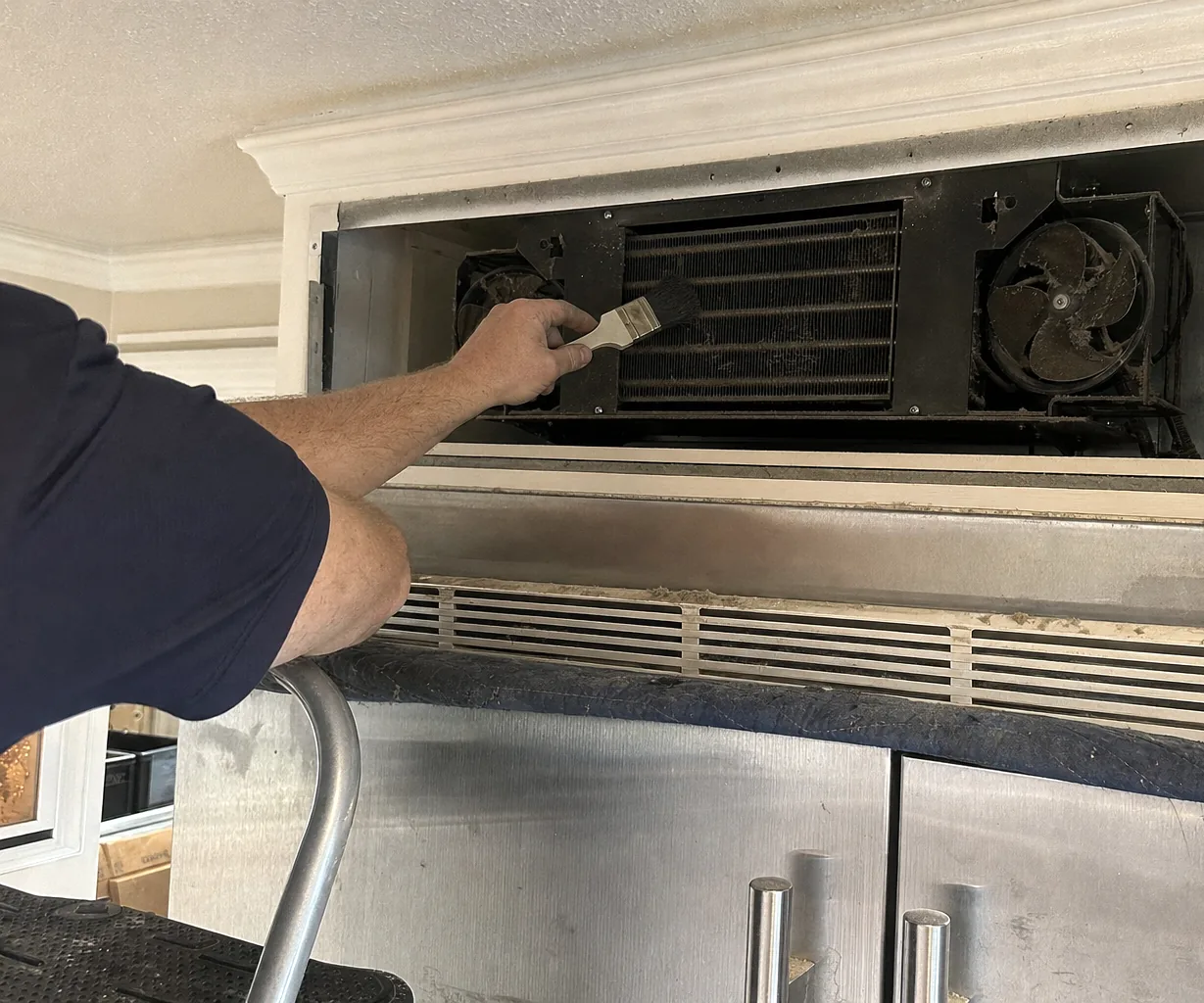
2. Condenser condition and discharge air
Temperature of the air leaving the grille, plus a look at the coil. Because airflow loss produces the same presenting symptom as a low charge — a cabinet that will not hold on a hot day — and one of those two costs a fraction of the other.
In this climate the coil loads fast. A cabinet cleaned in November can be visibly matted by April, and the pollen bonds harder in a kitchen that spends six months near saturation.
3. Voltage under load
Read at the receptacle while the compressor starts. A reading taken at rest is close to meaningless. Marginal supply produces symptoms that impersonate almost every expensive fault on the machine: intermittent control behaviour, poor cooling, a compressor that will not start reliably.
4. Evaporator frost pattern
Interior panel off, and read the ice. Frost is evidence and it is directional.
Even frost across the whole coil is normal operation. Frost on the first third of the coil with bare metal beyond it suggests a low charge or a restriction. A solid block over the coil points at a defrost fault — and a defrost fault is inexpensive compared to what it is often mistaken for.
5. Air movement
Evaporator fan running, ducts clear, nothing stacked against the return. A stalled fan or a container blocking a duct gives a warm fresh-food section with a perfectly healthy sealed system behind it. Common, cheap, and frequently missed.
6. Door seal and room conditions
Perimeter contact test on the gasket, cabinet level in two axes, and the room’s temperature and humidity recorded. In a Jacksonville summer, a seal that has lost contact over a few inches loads the box with very wet air continuously, and that alone will hold a compartment several degrees above setpoint.
7. Only now, the sealed system
Gauges last. By this point everything cheaper has been eliminated in front of you and written down, so a sealed-system quote arrives with the evidence that made it necessary rather than as an assertion.
Sealed-system work requires EPA Section 608 certification to perform legally, which we hold. It also requires an honest conversation about the cabinet: a fifteen-year-old built-in with a straight door and an intact interior is generally worth the repair, and one that has already had two sealed-system repairs usually is not. We would rather have that conversation on the first visit than after you have paid for the third.
Why we write the numbers down
Every measurement above goes on the estimate. Not to look thorough — so that you can take the sheet to somebody else and get a second opinion on the same data. An independent shop that will not show its measurements is asking for trust it has not earned.